
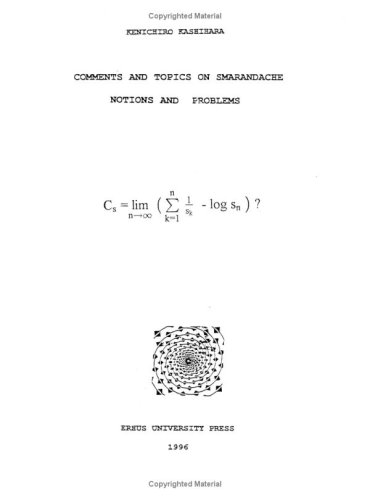
Comments and topics on Smarandache notions and problems
by Kenichiro Kashihara
Publisher: Erhus University Press 1996
ISBN/ASIN: 1879585553
ISBN-13: 9781879585553
Number of pages: 50
Description:
This book starts with an examination of some of the problems posed by Florentin Smarandache, one of the foremost mathematicians in the world today. The problems are from many different areas, such as sequences, primes and other aspects of number theory. Some of the problems are solved in the book, although in many cases the author raises additional questions. The second part of the book deals with a function created by the author and given the name the Pseudo Smarandache function.
Download or read it online for free here:
Download link
(1.4MB, PDF)
Similar books
 Geometric Theorems and Arithmetic Functions
by Jozsef Sandor - American Research Press
Contents: on Smarandache's Podaire theorem, Diophantine equation, the least common multiple of the first positive integers, limits related to prime numbers, a generalized bisector theorem, values of arithmetical functions and factorials, and more.
(18778 views)
 Lectures On Irregularities Of Distribution
by Wolfgang M. Schmidt - Tata Institute of Fundamental Research
The theory of Irregularities of Distribution began as a branch of Uniform Distributions, but is of independent interest. In these lectures the author restricted himself to distribution problems with a geometric interpretation.
(9281 views)
 Collections of Problems on Smarandache Notions
by Charles Ashbacher - Erhus University Press
This text deals with some advanced consequences of the Smarandache function. The reading of this book is a form of mindjoining, where the author tries to create the opportunity for a shared experience of an adventure.
(17433 views)
 Notes on Fermionic Fock Space for Number Theorists
by Greg W. Anderson - The University of Arizona
This is a compilation of exercises, worked examples and key references that the author compiled in order to help readers learn their way around fermionic Fock space. The text is suitable for use by graduate students with an interest in number theory.
(12369 views)