
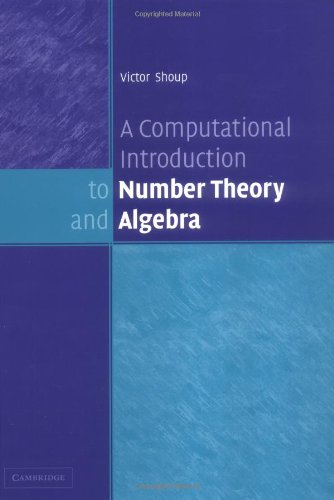
A Computational Introduction to Number Theory and Algebra
by Victor Shoup
Publisher: Cambridge University Press 2005
ISBN/ASIN: 0521851548
ISBN-13: 9780521851541
Number of pages: 534
Description:
Number theory and algebra play an increasingly significant role in computing and communications, as evidenced by the striking applications of these subjects to such fields as cryptography and coding theory. This introductory book emphasises algorithms and applications, such as cryptography and error correcting codes, and is accessible to a broad audience. The mathematical prerequisites are minimal: nothing beyond material in a typical undergraduate course in calculus is presumed, other than some experience in doing proofs - everything else is developed from scratch.
Download or read it online for free here:
Download link
(3.5MB, PDF)
Similar books
 Mathematics in the Age of the Turing Machine
by Thomas Hales - arXiv
Computers have rapidly become so pervasive in mathematics that future generations may look back to this day as a golden dawn. The article gives a survey of mathematical proofs that rely on computer calculations and formal proofs.
(16800 views)
 Vector Math for 3D Computer Graphics
by Bradley Kjell - Central Connecticut State University
A text on vector and matrix algebra from the viewpoint of computer graphics. It covers most vector and matrix topics needed for college-level computer graphics text books. Useful to computer science students interested in game programming.
(22958 views)
 Mathematics for Algorithm and Systems Analysis
by Edward A. Bender, S. Gill Williamson - Dover Publications
This text assists undergraduates in mastering the mathematical language to address problems in the field's many applications. It consists of 4 units: counting and listing, functions, decision trees and recursion, and basic concepts of graph theory.
(31967 views)
Algorithmic Mathematicsby Leonard Soicher, Franco Vivaldi - Queen Mary University of London
This text is a course in mathematical algorithms, intended for second year mathematics students. It introduces the algorithms for computing with integers, polynomials and vector spaces. The course requires no computing experience.
(24393 views)