
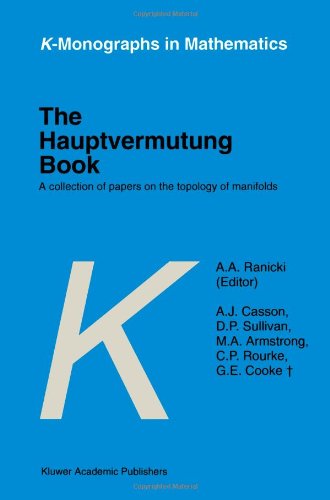
The Hauptvermutung Book: A Collection of Papers on the Topology of Manifolds
by A.A. Ranicki, et al,
Publisher: Springer 1996
ISBN/ASIN: 9048147352
ISBN-13: 9789048147359
Number of pages: 194
Description:
The Hauptvermutung is the conjecture that any two triangulations of a polyhedron are combinatorially equivalent. This conjecture was formulated at the turn of the century, and until its resolution was a central problem of topology. Initially, it was verified for low-dimensional polyhedra, and it might have been expected that further development of high-dimensional topology would lead to a verification in all dimensions.
Download or read it online for free here:
Download link
(740KB, PDF)
Similar books
 Surgery on Compact Manifolds
by C.T.C. Wall, A. A. Ranicki - American Mathematical Society
This book represents an attempt to collect and systematize the methods and main applications of the method of surgery, insofar as compact (but not necessarily connected, simply connected or closed) manifolds are involved.
(9530 views)
 Unsolved Problems in Virtual Knot Theory and Combinatorial Knot Theory
by R. Fenn, D.P. Ilyutko, L.H. Kauffman, V.O. Manturov - arXiv
The purpose of this paper is to give an introduction to virtual knot theory and to record a collection of research problems that the authors have found fascinating. The paper introduces the theory and discusses some problems in that context.
(6405 views)
 Exotic Homology Manifolds
by Frank Quinn, Andrew Ranicki
Homology manifolds were developed in the 20th century to give a precise setting for Poincare's ideas on duality. They are investigated using algebraic and geometric methods. This volume is the proceedings of a workshop held in 2003.
(9087 views)
 Combinatorial Knot Theory
by Louis H. Kauffman - University of Illinois at Chicago
This book is an introduction to knot theory and to Witten's approach to knot theory via his functional integral. Contents: Topics in combinatorial knot theory; State Models and State Summations; Vassiliev Invariants and Witten's Functional Integral.
(10736 views)