
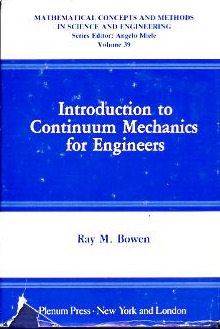
Introduction to Continuum Mechanics for Engineers
by Ray M. Bowen
Publisher: Springer 2007
ISBN/ASIN: 0306430509
ISBN-13: 9780306430503
Number of pages: 305
Description:
This textbook is intended to introduce engineering graduate students to the essentials of modern Continuum Mechanics. The objective of an introductory course is to establish certain classical continuum models within a modern framework. The book is essentially self contained and should be suitable for self study.
Download or read it online for free here:
Download link
(1.6MB, PDF)
Similar books
 Introduction to Mechanics and Symmetry
by Jerrold E. Marsden, Tudor S. Ratiu - Springer
This volume contains much of the basic theory of mechanics and should prove to be a useful foundation for further, as well as more specialized topics. As the name of the book implies, a consistent theme running through the book is that of symmetry.
(16586 views)
 Lecture Notes on Classical Mechanics
by Sunil Golwala - California Institute of Technology
These notes cover classical mechanics and special relativity. You will learn new techniques that will allow you to attack a wider set of problems than you saw in the introductory sequences as well as provide you a deeper understanding of physics.
(14490 views)
 Elementary Mechanics from a Mathematician's Viewpoint
by Michael Spivak - University of Georgia
Contents: The Hardest Part of Mechanics (The Fundamentals); How Newton Analyzed Planetary Motion; Systems of Particles; Conservation Laws; Rigid Bodies; Constraints; Holonomic and Non-Holonomic Constraints; Statically Indeterminate Structures.
(13390 views)
 Structure and Interpretation of Classical Mechanics
by Gerald Jay Sussman, Jack Wisdom - The MIT Press
The book emphasizes the development of general tools to support the analysis of nonlinear Hamiltonian systems. Explorations of transitions to chaos, nonlinear resonances, and resonance overlap to help the student to develop tools for understanding.
(16164 views)