
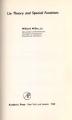
Lie Theory and Special Functions
by Willard Miller
Publisher: Academic Press 1968
ISBN/ASIN: 0124974503
ISBN-13: 9780124974500
Number of pages: 338
Description:
This monograph is the result of an attempt to understand the role played by special function theory in the formalism of mathematical physics. It demonstrates explicitly that special functions which arise in the study of mathematical models of physical phenomena are in many cases dictated by symmetry groups admitted by the models.
Download or read it online for free here:
Download link
(multiple PDF files)
Similar books
 Introduction to Physics for Mathematicians
by Igor Dolgachev
A set of class notes taken by math graduate students, the goal of the course was to introduce some basic concepts from theoretical physics which play so fundamental role in a recent intermarriage between physics and pure mathematics.
(16869 views)
 Topics in Spectral Theory
by Vojkan Jaksic - McGill University
The subject of these lecture notes is spectral theory of self-adjoint operators and some of its applications to mathematical physics. The main theme is the interplay between spectral theory of self-adjoint operators and classical harmonic analysis.
(9066 views)
 Introduction to Spectral Theory of Schrödinger Operators
by A. Pankov - Vinnitsa State Pedagogical University
Contents: Operators in Hilbert spaces; Spectral theorem of self-adjoint operators; Compact operators and the Hilbert-Schmidt theorem; Perturbation of discrete spectrum; Variational principles; One-dimensional Schroedinger operator; etc.
(9281 views)
 A Window into Zeta and Modular Physics
by Klaus Kirsten, Floyd L. Williams - Cambridge University Press
This book provides an introduction, with applications, to three interconnected mathematical topics: zeta functions in their rich variety; modular forms; vertex operator algebras. Applications of the material to physics are presented.
(10541 views)