
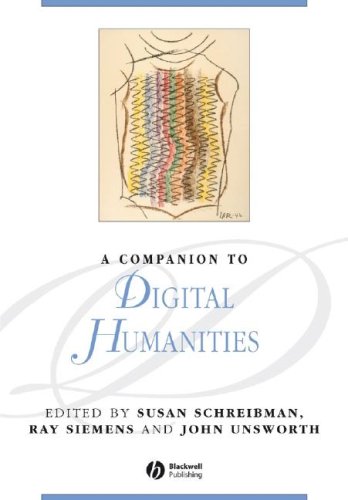
A Companion to Digital Humanities
by Susan Schreibman, Ray Siemens, John Unsworth
Publisher: Wiley-Blackwell 2004
ISBN/ASIN: 1405168064
ISBN-13: 9781405168069
Number of pages: 640
Description:
Provides a complete yet concise overview of this emerging discipline. The volume was written by leaders in the field, addressing the central concerns of those interested in the subject. The articles are grouped into topical sections focusing on the experience of particular disciplines in applying computational methods to humanities research problems; the basic principles of humanities computing across applications and disciplines; specific applications and methods; and production, dissemination, and archiving.
Download or read it online for free here:
Read online
(online reading)
Similar books
 Interdisciplining Digital Humanities
by Julie Thompson Klein - University of Michigan Press
The book sorts through definitions and patterns of practice over roughly 65 years of work, providing an overview for specialists and the general audience alike. It depicts the ways this new field is being situated within individual domains ...
(6980 views)
 Statistics for the Humanities
by John Canning - British Academy
This book is a beginner's guide to statistics which uses examples from the humanities subjects. The book is aimed primarily at undergraduate humanities students, especially those who have not studied mathematics since the age of 16.
(8479 views)
 Studies on the Legend of the Holy Grail
by Alfred Nutt - The Folk-lore Society
The present work is a collection of 'Studies.' It does not profess to give an exhaustive or orderly account of the Grail romance cycle; it deals with particular aspects of the legend, and makes no pretence of exhausting even these.
(7881 views)
 Digital Humanities Pedagogy: Practices, Principles and Politics
by Brett Hirsch (ed.) - Open Book Publishers
The book offers views on the practical realities of teaching digital humanities at undergraduate and graduate levels, presenting case studies of the experiences alongside models for future courses and reflections on pedagogical successes or failures.
(6971 views)