
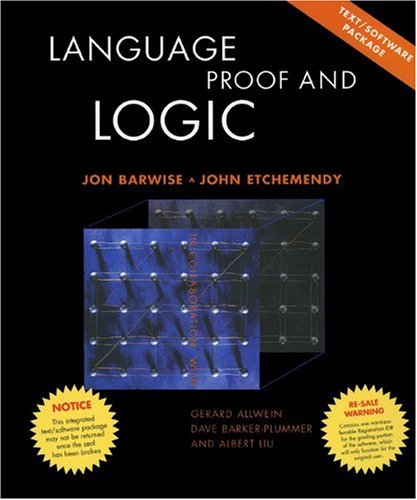
Language, Proof and Logic
by Jon Barwise, John Etchemendy
Publisher: Center for the Study of Language 2011
ISBN/ASIN: 157586374X
ISBN-13: 9781575863740
Number of pages: 620
Description:
This textbook/software package covers first-order language in a method appropriate for first and second courses in logic. The unique on-line grading services instantly grades solutions to hundred of computer exercises. It is specially devised to be used by philosophy instructors in a way that is useful to undergraduates of philosophy, computer science, mathematics, and linguistics. Advanced chapters include proofs of soundness and completeness for propositional and predicate logic, as well as an accessible sketch of Godel's first incompleteness theorem.
Download or read it online for free here:
Download link
(2.5MB, PDF)
Similar books
 How Mobile Robots Can Self-organise a Vocabulary
by Paul Vogt - Language Science Press
This book presents a series of experiments in which two robots try to solve the symbol grounding problem. The experiments are based on the language game paradigm, and involve real mobile robots that are able to develop a grounded lexicon ...
(6359 views)
 Natural Language Processing for the Working Programmer
by Daniël de Kok, Harm Brouwer
We will go into many of the techniques that so-called computational linguists use to analyze the structure of human language, and transform it into a form that computers work with. We chose Haskell as the main programming language for this book.
(16639 views)
 Stochastic Attribute-Value Grammars
by Rob Malouf, Miles Osborne - ESSLLI
This text provides an introduction to the maximum entropy principle and the construction of maximum entropy models for natural language processing. We investigate the implementation of maximum entropy models for attribute-value grammars.
(9263 views)
 A Maximum Entropy Approach to Natural Language Processing
by A. L. Berger, S. A. Della Pietra, V. J. Della Pietra - Association for Computational Linguistics
The authors describe a method for statistical modeling based on maximum entropy. They present a maximum-likelihood approach for automatically constructing maximum entropy models and describe how to implement this approach efficiently.
(10449 views)