
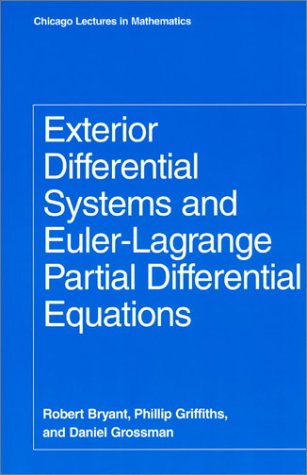
Exterior Differential Systems and Euler-Lagrange Partial Differential Equations
by R. Bryant, P. Griffiths, D. Grossman
Publisher: University Of Chicago Press 2008
ISBN/ASIN: 0226077942
ISBN-13: 9780226077949
Number of pages: 219
Description:
The authors present the results of their ongoing development of a theory of the geometry of differential equations, focusing especially on Lagrangians and Poincaré-Cartan forms. They also cover certain aspects of the theory of exterior differential systems, which provides the language and techniques for the entire study.
Download or read it online for free here:
Download link
(1.6MB, PDF)
Similar books
 Projective Differential Geometry Old and New
by V. Ovsienko, S. Tabachnikov - Cambridge University Press
This book provides a route for graduate students and researchers to contemplate the frontiers of contemporary research in projective geometry. The authors include exercises and historical comments relating the basic ideas to a broader context.
(17759 views)
 Lectures on Fibre Bundles and Differential Geometry
by J.L. Koszul - Tata Institute of Fundamental Research
From the table of contents: Differential Calculus; Differentiable Bundles; Connections on Principal Bundles; Holonomy Groups; Vector Bundles and Derivation Laws; Holomorphic Connections (Complex vector bundles, Almost complex manifolds, etc.).
(10987 views)
 An Introduction to Gaussian Geometry
by Sigmundur Gudmundsson - Lund University
These notes introduce the beautiful theory of Gaussian geometry i.e. the theory of curves and surfaces in three dimensional Euclidean space. The text is written for students with a good understanding of linear algebra and real analysis.
(11684 views)
 A Geometric Approach to Differential Forms
by David Bachman - arXiv
This is a textbook on differential forms. The primary target audience is sophomore level undergraduates enrolled in a course in vector calculus. Later chapters will be of interest to advanced undergraduate and beginning graduate students.
(15974 views)