
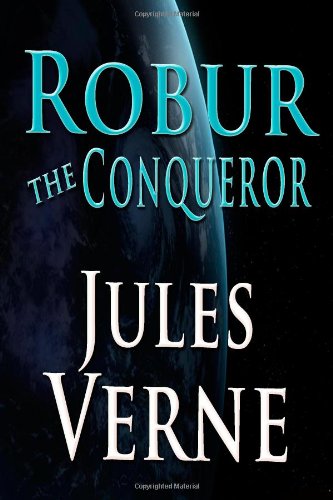
Robur the Conqueror
by Jules Verne
Publisher: Pierre-Jules Hetzel 1886
ISBN/ASIN: 1440414254
Number of pages: 361
Description:
Robur the Conqueror is a science fiction novel by Jules Verne. The story begins with strange lights and sounds, including blaring trumpet music, reported in the skies all over the world. The events are capped by the mysterious appearance of black flags with gold suns atop tall historic landmarks such as the Statue of Liberty in New York, the Great Pyramid of Giza in Egypt, and the Eiffel Tower in Paris.
Download or read it online for free here:
Download link
(multiple formats)
Similar books
 The Lost World
by Sir Arthur Conan Doyle - Hodder & Stoughton
Classic adventure by Sir Arthur Conan Doyle which uses the written word to visualize the mysterious world of pterodactyls, plesiosaurs and iguanadons roaming the earth in the 20th century. An SF adventure into the dense jungles of South America.
(16236 views)
 Star Maker
by William Olaf Stapledon - Feedbooks
A poetic and deeply philosophical work, the true classics of SF. The book challenges preconceived notions of intelligence and awareness, and ultimately argues for a broadened perspective that would free us from our inevitable anthropomorphism.
(13098 views)
 The Time Machine
by H. G. Wells - Project Gutenberg
The novel is considered one of the earliest works of science fiction and the progenitor of the 'time travel' subgenre. Wells advanced his social and political ideas in this narrative of a nameless Time Traveller who is hurtled into the year 802,701.
(16093 views)
 A Voyage to Arcturus
by David Lindsay - Feedbooks
One of the most revered classics of science fiction, it has inspired, enchanted, and unsettled readers for decades. It is simultaneously an epic quest across one of the most unusual and brilliantly depicted alien worlds ever conceived.
(8389 views)